When does the Pimax Black Friday 2026 sale end?+
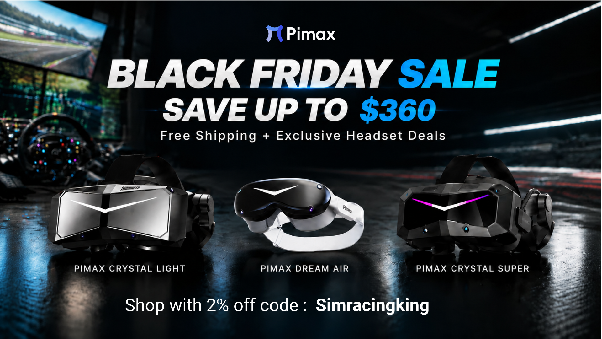
The official sale runs from November 16 to December 5, 2026. Free global shipping is included throughout, and code Simracingking adds an extra 2% off the Black Friday price.
Which Pimax VR headset is best for iRacing?+
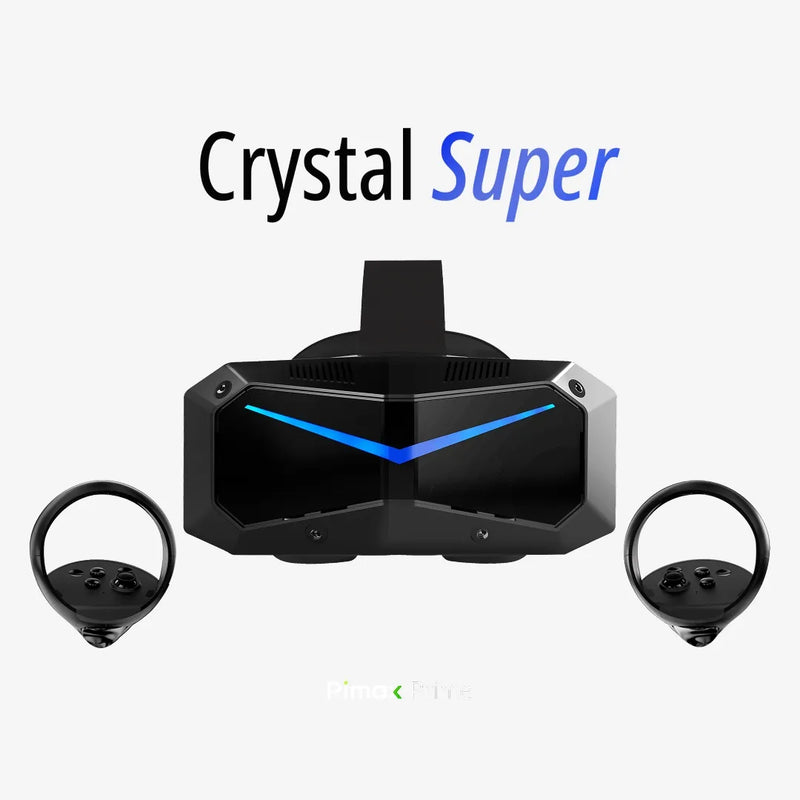
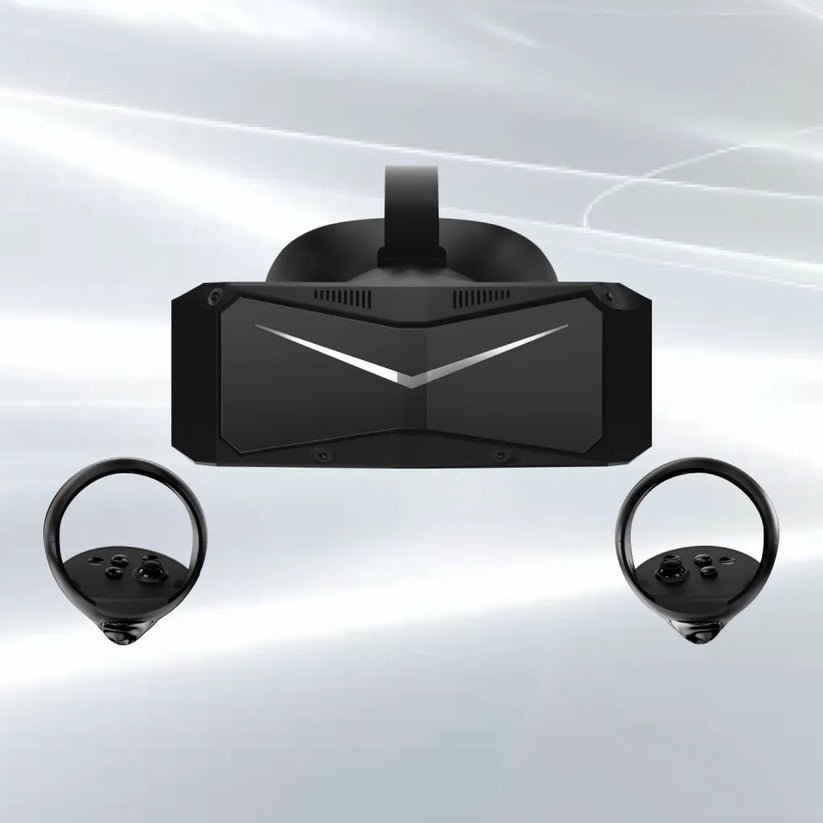
It depends on your GPU, visual priorities, tracking setup and budget. The Crystal Super suits racers who prioritize cockpit detail and pixel density (50 PPD with 127° horizontal FOV, or 57 PPD with 106°). The Dream Air is a lightweight Micro-OLED option with Tobii eye tracking and dynamic foveated rendering. The Dream Air SE offers the same strengths at a lower price, and the Crystal Light is the most accessible high-resolution option at 35 PPD and 110° horizontal FOV.
What GPU do I need to run a Pimax headset for sim racing?+
For the Crystal Light, Pimax recommends an RTX 3080 or RTX 4070 class GPU for medium-quality simulation, with RTX 4070 Ti, 4080 or 4090 for a better experience. The Crystal Super is more demanding: Pimax recommends an RTX 4080, and an RTX 4090 for its best-experience configuration. iRacing, Assetto Corsa Competizione and other sims have very different performance requirements, so settings will vary by title.
Can I use a Pimax headset with an RTX 3080, RTX 4080 or RTX 4090?+
Yes. An RTX 3080 is a reasonable starting point for the Crystal Light and can run higher-end models with adjusted settings. An RTX 4080 is a stronger choice for high-resolution PC VR and the Crystal Super, and an RTX 4090 gives the most headroom for demanding sims. Your CPU, sim, track, grid size and graphics settings also affect performance; no GPU guarantees a specific frame rate.
Is higher resolution always better for sim racing?+
Not necessarily. Higher resolution makes dashboards, road markings and distant objects easier to read, but it increases GPU load. Pixels per degree (PPD) is a useful measure: the Crystal Light offers 35 PPD, the Crystal Super QLED 50 PPD with a wider 127° FOV, or 57 PPD with 106° FOV. If you read small dashboard displays a lot, density matters; if you prefer peripheral vision, compare the 50 PPD option.
What is the difference between SLAM and Lighthouse tracking? Which should sim racers choose?+
SLAM uses inside-out tracking, so you don't need external base stations, which makes for a simpler setup. Lighthouse uses external SteamVR base stations and makes sense if you already own them. For seated sim racing, consider your existing hardware and how you'll use the headset beyond racing.
Do Pimax headsets support eye tracking and Dynamic Foveated Rendering?+
Selected models do. The Dream Air and Dream Air SE include Tobii eye tracking, and the Crystal Super supports eye tracking and dynamic foveated rendering. DFR renders the area you're looking at in full detail, which can reduce GPU load in supported games. The Crystal Light does not include built-in eye tracking.
Is 72Hz or 90Hz enough for sim racing?+
Both can work well. A higher refresh rate looks smoother but demands more from your GPU. For most sim racers, holding a stable frame rate matters more than choosing the highest refresh rate and suffering frequent drops.
Are Pimax headsets compatible with popular racing sims?+
Pimax PC VR headsets work with PC VR platforms and supported OpenXR and SteamVR applications, including iRacing, Assetto Corsa, Assetto Corsa Competizione, Automobilista 2, Le Mans Ultimate and RaceRoom Racing Experience.